Why the Waistband on Seamless Leggings Rolls Even When the Fit Is Right
Quick Answer: Seamless leggings are knitted as a single tube with the waistband knitted in rather than sewn on, so there is no separate elastic band holding a fixed circumference. When your torso changes shape as you move or sit, the band has nothing rigid to resist against and folds. Sizing up makes it worse because a looser band has even less tension to hold its position.
They fit perfectly. They are the right size. You checked.
And twenty minutes into the class the band has folded over into a rope across your stomach.
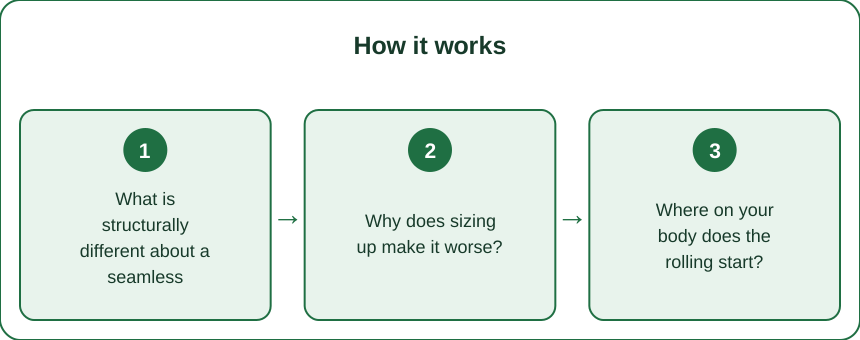
What is structurally different about a seamless waistband?
Almost everything, and it is worth understanding because it explains why the usual fixes fail.
A traditional sewn legging has a separate waistband — often a folded double layer, sometimes with elastic inside — stitched to the body of the garment. That band has a fixed circumference and its own tension independent of the leg fabric. It resists rolling because it is structurally a different piece.
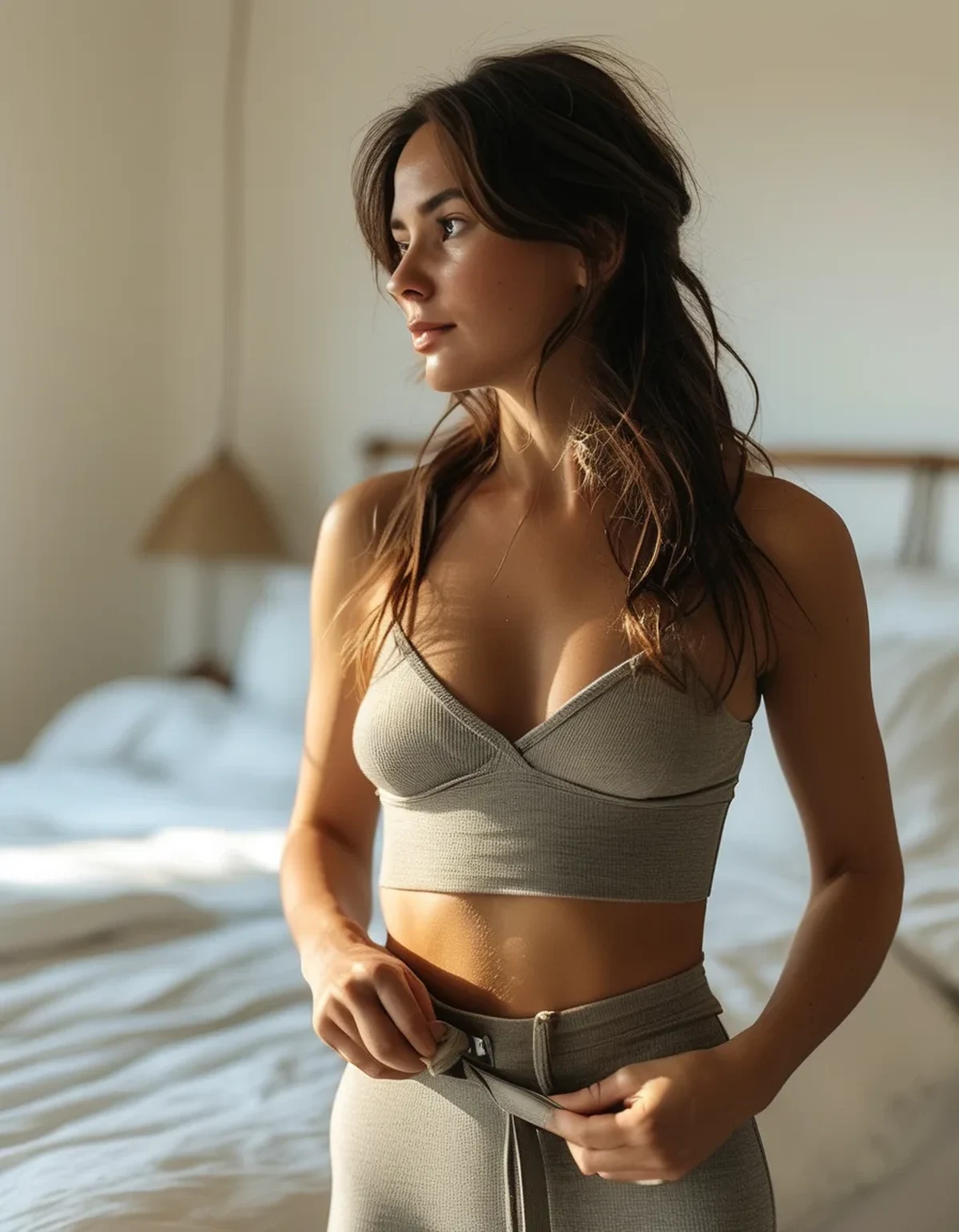
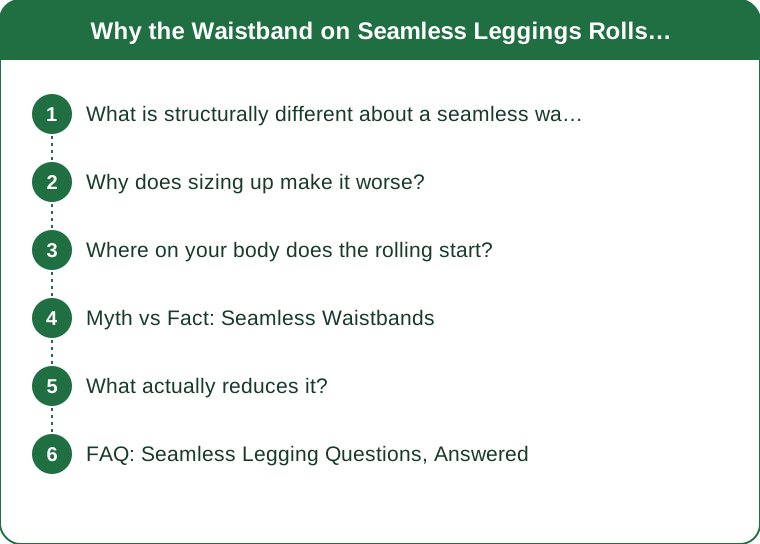
A seamless legging is knitted on a circular machine as one continuous tube. The waistband is a change in knit structure — usually a denser stitch or a rib — not a separate component. There is no independent band, only a zone of the same fabric knitted differently.
That construction is exactly why seamless feels so smooth and invisible under clothes. It is also exactly why the waistband has less structure to resist folding when your body changes shape underneath it.
Why does sizing up make it worse?
Because the seamless waistband holds position through tension against your body, and less tension means less grip.
With a sewn elastic band, sizing up gives you a band that is still structurally rigid, just larger. It may slide down, but it tends not to fold.
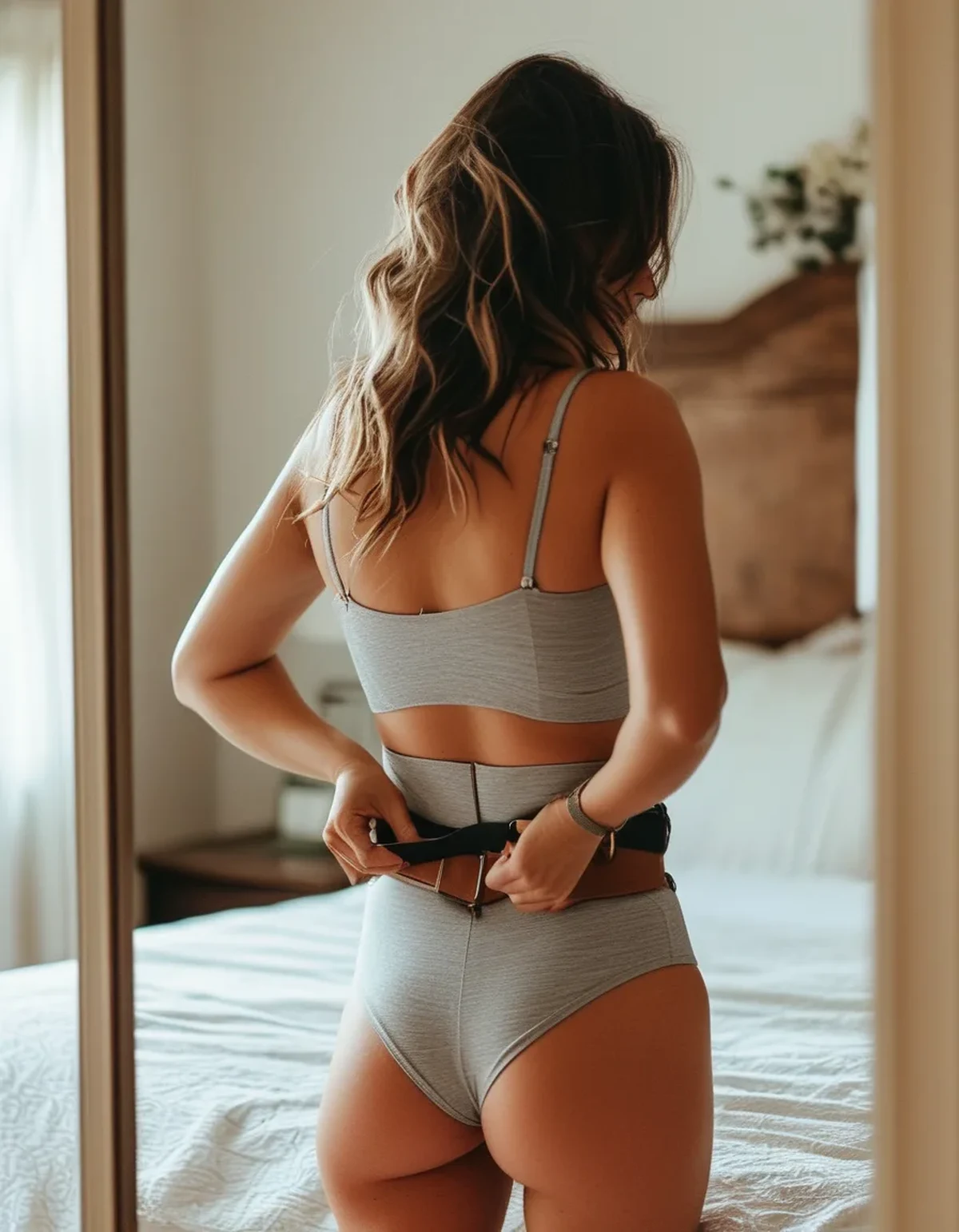
With a seamless band, sizing up removes the very thing keeping it flat. The band now sits loosely against your waist, and the moment your torso flexes, it has no reason to stay where it is. It folds along the path of least resistance — which is the crease at the front of your hip when you bend.
So the intuitive response to rolling (buy a size up for comfort) is often the wrong one for this specific construction. If your seamless leggings roll, the size is more likely correct-to-slightly-large than too small.
The exception: if the band is genuinely digging in and creating a visible ridge, that is too small, and that is a different problem with a different fix.
Where on your body does the rolling start?
Almost always at the front, at the crease where your torso folds when you bend or sit.
That crease compresses fabric vertically. The band is pushed up from below and down from above at the same time, and a knitted band with no rigid structure resolves that by folding outward. Once the fold starts, it becomes a permanent path — the fabric has been creased and it will refold in the same place within minutes.
This is why rolling gets worse over the life of a pair. The first fold is caused by movement. Every subsequent fold is caused by the memory of the first.
It also explains the specific pattern where the band rolls only on one side. If you consistently carry a bag on one hip, sit with one leg crossed, or have any asymmetry in how you move, that side creases first and keeps creasing.
Rise height matters here too. A band that sits exactly at your natural waist crease is in the worst possible position. Either higher (above the crease, against the ribs) or lower (below it, on the hip) is more stable.
Myth vs Fact: Seamless Waistbands
Myth: Rolling means the leggings are cheap. Fact: it is a construction characteristic, present across price points. Expensive seamless leggings roll too. What price buys you is usually a wider band, better recovery in the yarn, and sometimes a silicone gripper — all of which reduce it without eliminating the underlying cause.
Myth: Sizing up fixes it. Fact: it usually makes it worse, for the reasons above. Sizing down is also not the answer — that trades rolling for digging.
Myth: A drawstring would solve it. Fact: drawstrings are rare in seamless construction because there is no separate band to house one, and adding one would create the exact bulk seamless exists to avoid.
Myth: The dryer causes it. Fact: heat damages elastane recovery, which reduces the band’s tension over time, so heat makes existing rolling worse. But the tendency is there from day one. Air drying preserves what you have; it does not create structure that was never there.
What actually reduces it?
Ranked by how much difference they make:
Choose a wider band. A 4-6 inch knitted band distributes the fold pressure over more fabric and resists creasing far better than a 2-inch one. This is the biggest single factor when buying.
Choose a rise that avoids your crease. Try the band an inch above where you usually wear it. Many people find their rolling stops entirely at a slightly higher position.
Look for a silicone gripper or elastic thread at the top edge. Some seamless designs add a thin silicone line inside the top of the band. It adds a small amount of grip and meaningfully reduces migration.
Wash cold, air dry, no fabric softener. Softener coats elastane and reduces recovery, which directly reduces the tension holding the band up. Heat does the same faster.
Rotate pairs. Elastane needs 24 hours to fully recover its shape. Wearing the same pair two days running means the second day starts with less tension than the first.
What does not work: folding the band down deliberately (creates a permanent crease), or tucking a top under it (adds a slippery layer between the band and skin, which is what was holding it in place).
FAQ: Seamless Legging Questions, Answered
Should I buy sewn-seam leggings instead if rolling bothers me?
If the waistband is your main complaint, yes — a bonded or sewn wide band with proper elastic is structurally better at staying put. You trade the invisible-under-clothes smoothness that made you buy seamless in the first place. It is a genuine tradeoff rather than one option being better.
Why do they roll more when I wear a longer top?
Fabric over the band adds weight and friction that pushes it down at the same time as your movement pushes it up. Cropped tops and tucked-in layers roll less. If a specific pair only rolls with certain tops, that is why.
My leggings started rolling after six months. What changed?
Elastane recovery. The yarn loses tension gradually with every wash and wear, and heat accelerates it substantially. A pair that held its band for months and now folds every session has lost the tension it was relying on. Cold wash and air dry from the start extends this significantly — often by a season or more.
TL;DR:
- Seamless waistbands are a knit-structure change, not a separate band, so they have less to resist folding.
- Sizing up reduces the tension holding the band in place and usually makes rolling worse.
- Rolling starts at the front hip crease and repeats along the same fold once established.
- Wider bands, a rise above your natural crease, and silicone grippers are what actually help.
- Cold wash, air dry, skip the softener, and rotate pairs to preserve elastane tension.
The practical thing to test this week costs nothing: pull the band an inch higher than you normally wear it and do a full session. For a lot of people that single adjustment moves the band off the crease that was causing the fold, and the problem they assumed was a sizing mistake turns out to have been a placement one.
See It in Motion
Seen here: Super High Waist Embossed Yoga Leggings with Inner Pocket — shop it on bubblelime.com
Keep Reading
This article is for general informational and styling purposes only. Fit, sizing, and product availability may vary.