Why Seamless Leggings Size Differently Than Everything Else You Own
Quick Answer: Regular leggings are cut from stretch fabric into many graded sizes and sewn; seamless leggings are knitted in the round as tubes, in only two to four machine sizes, with the stretch of the knit structure itself expected to bridge everything between. That is why the size chart lumps S with M, why your dress size is a weak predictor, why the same size varies between colors, and why the fit changes over the first few wears as the knit relaxes to your shape. The rules that follow: when between sizes, size up for compression comfort; judge fit after three wears, not in the first minute; and read squat-proofness at the fabric level, not the size label.
Here is how the tube changes everything, and how to buy your actual size.
What is actually different about how seamless is made?
The garment is knitted as a tube, and the tube is the explanation for every sizing quirk you have noticed.
Cut-and-sew leggings — most yoga pants, including premium ones — start as flat stretch fabric, cut into shaped panels for each size on a graded pattern, then sewn. The brand drafts a distinct pattern per size, so an XS through XL range means five engineered shapes, each with modest stretch doing fine-tuning.
Seamless leggings come off circular knitting machines as continuous tubes — the shaping is knitted in by varying stitch structure: denser compressive zones at the waist, ribbed texture under the seat, lighter mesh-like zones behind the knee. The machine cylinder comes in a small number of fixed diameters, which is why seamless lines offer S/M and L/XL where cut-and-sew offers five sizes — the knit’s enormous mechanical stretch is expected to do the work of the three missing patterns.
That substitution — structure stretching instead of pattern grading — creates the behaviors that confuse buyers. The garment relies on negative ease: it measures dramatically smaller flat than your body and is engineered to stretch far and recover. How it feels therefore depends on where in the stretch range your body lands — near the bottom of a size band, gentle; near the top of the same letter, noticeably compressive. Two friends wearing the same S/M are wearing meaningfully different amounts of squeeze.
It also explains the first-hour lie: fresh off the machine and through its heat-setting, a seamless knit is at its tightest and springiest. The first wear reads a half-size smaller than the fifth wear, because the loops need a few wear-and-wash cycles to settle into their working geometry around your specific shape. Judging seamless fit in a changing-room minute is measuring the least representative moment the garment will ever have.
So how do you actually pick your size?
Four rules, in the order they should override each other.
Rule one: measure hips, ignore your dress size. Seamless charts are hip-circumference bands, and the hip number decides which side of a two-size band you fall on. Your jeans size and even your cut-and-sew legging size are weak predictors, because neither was assigned by a knitting cylinder. Thirty seconds with a tape measure beats every review you will read.
Rule two: between sizes, go up — the opposite of the old compression instinct. In cut-and-sew, sizing down is how some people chase a compressive feel. In seamless, sizing down pushes you toward the top of the knit’s stretch range, where three bad things live: the fabric thins and sheers under stretch — the number-one cause of a squat-proof style failing on one specific body — the waistband curls and rolls because it is fighting at maximum extension, and the compressive knit zones land in the wrong places because the whole map stretched past its design position. Sized-up seamless still compresses — that is the knit structure’s job — it just does it where it was engineered to.
Rule three: give it three wears before verdicts. The settling described above is real: waistband ease, thigh feel, and length all shift slightly as the loops relax. Buy, wear at home three times, then decide. Most this-runs-small reviews are first-hour reviews.
Rule four: expect variation the label will not admit. Different colorways of the same style can fit slightly differently — dye processes change yarn behavior — and seamless production tolerances are looser than cut-and-sew. If a reorder feels different from your beloved first pair, you are not imagining it; buy the color you love in your size when you see it, because the identical restock is only mostly identical.
One more calibration: seamless sits closer to the body than brushed buttery-soft leggings at the same nominal size, because clingy structure is the product. If your reference point for legging comfort is a soft high-waisted pair with a relaxed knit, expect your correct seamless size to feel one notch more present — that is the category, not a sizing error.

Myth vs Fact: Seamless Sizing
Myth: seamless means one size fits all. Fact: it means each machine size fits a range — which is a real engineering achievement and still has edges. Bodies near a band’s boundary genuinely fit both adjacent sizes differently and get to choose by preference: lower band for more compression, upper for more ease.
Myth: sizing down makes seamless more squat-proof. Fact: exactly backward. Sheerness under a squat is fabric stretched past its opacity threshold — sizing down moves you toward that threshold, sizing up moves you away from it. The squat-test in the mirror, in your actual size, in daylight, remains the only verdict that counts.
Myth: seamless has no seams. Fact: the tube has no side seams, but gussets, waistbands, and leg joins still involve joining — usually flat-locked or linked. The marketing word is mostly-seamless; the fit consequence is real though: no side-seam skeleton means nothing holds a rigid vertical line, which is why seamless follows your shape more literally than cut-and-sew — in both directions, flattering and honest.
Myth: if it feels tight at first, it is too small. Fact: maybe — or it is a fresh knit at its springiest. The distinction: too-small announces itself with a waistband that folds down, sheering over the seat in the mirror, and compression zones sitting visibly wrong. Snug-but-mapped-correctly relaxes into right by wear three; genuinely-wrong gets worse.
Myth: seamless stretches out and is ruined faster. Fact: quality seamless recovers extremely well — the same loop structure that stretches far snaps back hard, and many seamless pairs outlast cut-and-sew at the seams because there are no side seams to blow. What kills them is heat: dryers cook the elastane that powers all that recovery. Cold wash, hang dry, and the tube keeps its memory for years.
Myth: the size chart lumping sizes means the brand is cutting corners. Fact: it means the brand is being honest about how many cylinders the machine has. Suspicion is better aimed at seamless lines claiming five distinct sizes with identical measurements two by two.
How should this change what you buy for what?
Match the knit’s strengths to the job, and let cut-and-sew keep the jobs it wins.
Seamless shines where movement is multidirectional and friction matters: yoga, pilates, studio classes, lounging, sleep-adjacent wear, and anything where a side seam would print or rub. The no-seam tube plus mapped compression zones is genuinely the superior technology for twisting, folding bodies — and its second-skin cling under fitted dresses and long shirts makes it the layering legging of choice.
Cut-and-sew keeps the crown for structure and precision: heavy lifting days where you want a locked-in, sculpted waistband; bootcut leggings and flares, whose shaped leg lines need pattern-cut panels a tube cannot knit; and pockets — seamless phone pockets remain rare and mediocre because knitting a stable pocket into a stretch tube is genuinely hard. If your week is squats and errands, the compressive cut-and-sew pair with real pockets is still the workhorse.
Buy seamless in this order: measure hips, pick the band — rounding up between sizes — order one, run the three-wear settle, do the daylight squat test, and only then multiply into colors. Given colorway variation, multiplying within a batch you can try beats trusting a future restock.
Care for the elastane like it is the product, because it is: cold wash, inside out, no dryer, no fabric softener — softener coats the very fibers whose grip and recovery you paid for. A seamless pair treated this way holds its map for years; one dryer summer ages it three.
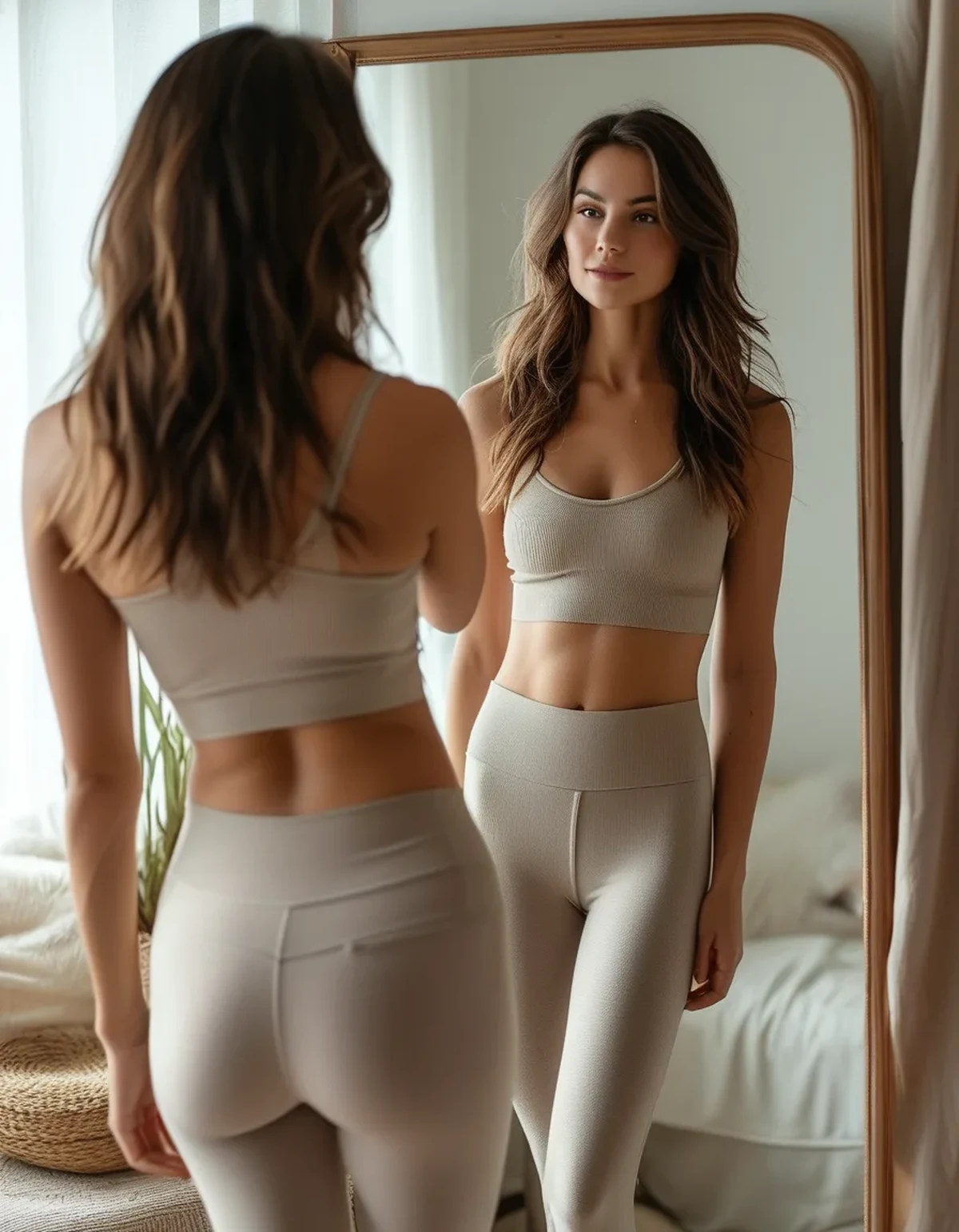
And a final honest calibration for the mirror moment: seamless follows your actual shape by design — that literal honesty is why it feels like nothing and moves like skin, and why the first look can surprise anyone used to compression-sculpted cut-and-sew. Give it the three wears. The pair that fits your measured size, settled to your shape, is the one that disappears on your body — which was the entire point of knitting it as a tube in the first place.
FAQ: Seamless Sizing Questions, Answered
My hips are S but my waist is M on the chart. Which wins?
Hips win — the knit’s stretch handles waist variation far more gracefully than seat-and-hip variation, and the waistband zone is knitted denser precisely to adapt. Sized to your hips, a proportionally smaller waist just gets slightly gentler waistband pressure, which most people prefer anyway.
Why does the same size fit differently in my two colors?
Dye lots and processes change yarn tension and behavior slightly, and seamless tolerances are wider than cut-and-sew. It is a known trait of the category, not a defect worth returning unless the fit difference is dramatic — in which case one of them likely came from the edge of tolerance and a swap is fair.
Are seamless leggings squat-proof enough for the gym?
Many are, in the right size — the failure mode is almost always fabric at maximum stretch, which is a sizing-down artifact. Test yours: daylight, mirror, full deep squat with a phone flashlight behind you if you are serious. Pass in your size and it will keep passing; borderline, and the same style one size up usually passes comfortably.
Do I need different sizes in seamless shorts or bras from the same brand?
Possibly — each garment type comes off different machine setups, and bra sizing adds support requirements that stretch bands handle worse than leg tubes. Treat every seamless category as its own sizing question with the same rules: measure, round up when between, three wears before judging.
TL;DR:
- Seamless is knitted as a tube in two to four machine sizes, with the knit’s stretch replacing the missing patterns — that is the root of every sizing quirk.
- Measure your hips and trust the chart over your dress size; between sizes, go up — sizing down causes sheerness, rolling waistbands, and misplaced compression.
- Judge fit after three wears: fresh knits read a half-size small and settle to your shape. Expect small variation between colors and batches.
- Use seamless for yoga, studio, and layering; keep cut-and-sew for heavy lifting, flares and bootcuts, and real pockets. Protect the elastane: cold wash, no dryer, no softener.
Tonight, take the tape measure to your hips and check it against the chart of the pair you have been side-eyeing. If you have been buying by instinct, there is a decent chance you have been one band off the whole time — and the fix costs nothing but the measurement.
See It in Motion
Seen here: High Waist Bootcut Yoga Pants with Hidden Pocket — shop it on bubblelime.com
Keep Reading
This article is for general informational and styling purposes only. Fit, sizing, and product availability may vary.