Why Seamless Leggings Feel Thinner in Cold Weather Even Though Nothing Changed
Quick Answer: Seamless leggings are knitted as a single tube with varying stitch density, which creates deliberately open, breathable zones. Those zones let heat escape as designed. In cold weather, the same construction that kept you cool becomes a set of thermal gaps, so the leggings feel thin and patchy rather than uniformly warm — even though the fabric is identical to what it was in July.
They felt substantial all summer. First cold morning, you put on the same pair and they feel like nothing — and specifically, cold in particular places rather than uniformly.
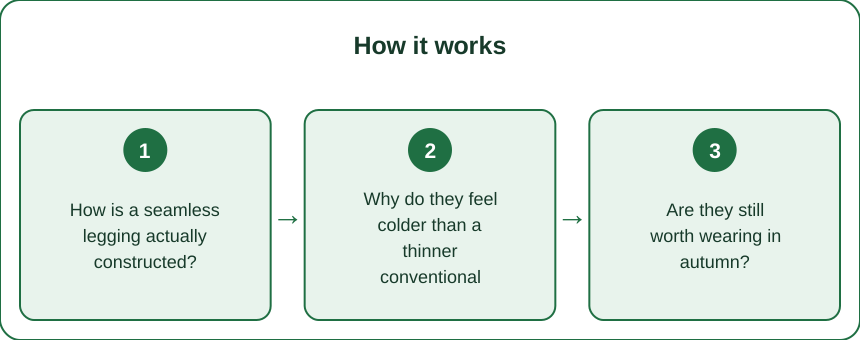
How is a seamless legging actually constructed?
As a single knitted tube, which is the source of both its strengths and this problem.
A conventional legging is cut from flat fabric and sewn together. A seamless one is knitted in the round on a circular machine, with the stitch pattern varying across the garment to create different properties in different zones.
Those zones are deliberate. Denser knit where support is wanted — the waistband, the outer thigh, the seat. More open, mesh-like knit where ventilation is wanted — behind the knee, the inner thigh, sometimes the calf.
In warm weather this is excellent engineering. The open zones dump heat exactly where you generate it and where airflow is available.
In cold weather those same zones are thermal holes. Heat escapes through them at a rate that has nothing to do with the fabric’s overall weight, which is why the leggings feel cold in specific patches rather than generally thin. The behind-the-knee panel is usually the first place people notice.
Why do they feel colder than a thinner conventional legging?
Because uniform coverage beats average thickness for warmth.
A conventional legging of the same overall weight distributes its fabric evenly. There are no deliberately open zones, so there is no concentrated heat loss anywhere. A uniformly thin fabric is warmer than a fabric that averages the same weight but has ventilation panels, because heat escapes preferentially through the path of least resistance.
There is a wind element too. Open knit structures are essentially transparent to wind, so any breeze cuts straight through the ventilation zones. A conventional knit slows air considerably more even at the same weight.
And a moisture element. In cool weather, the ventilation zones that were evaporating sweat efficiently now let cold air reach damp skin directly. The mesh panel behind your knee going from an asset to a liability is the single most common seasonal complaint about seamless activewear, and it is a design consequence rather than a quality problem.
Are they still worth wearing in autumn?
For some uses, yes, and the distinction is about where you are and how hard you are working.
Good autumn uses for seamless:
- Indoor training, where the ventilation is still doing its job and there is no wind
- As a base layer under something else, where the open zones are covered and the smooth surface makes it comfortable underneath
- High-intensity outdoor work where you generate enough heat to overcome the losses
- Studio classes in heated rooms, which is arguably where seamless performs best year-round
Poor autumn uses:
- Anything outdoors and windy
- Low-intensity outdoor activity, particularly walking, where you are not producing much heat
- Anything with a warm-up-then-stand-around structure, which is the classic combination for getting cold
- Cool-weather runs where you finish damp and then stop
The simple version: seamless is a warm-and-active fabric, not a cold-and-static one. Matching it to the right session is more effective than trying to make it warmer.
Myth vs Fact: Seamless in Cold Weather
Myth: Seamless leggings are lower quality because they feel thin in the cold. Fact: They are engineered for a different priority. Zoned ventilation and no seams to chafe are genuine advantages in warm conditions, and the same features are disadvantages in cold ones. It is a specification, not a defect.
Myth: A thicker seamless pair solves it. Fact: Partially. Heavier seamless knits do exist and are warmer, but the ventilation zones are usually still present because that is how the construction works. The zoned heat loss is reduced, not eliminated.
Myth: Layering under seamless works fine. Fact: It usually does not — seamless is compressive and close-fitting, so anything underneath bunches. Seamless works far better as the under-layer than the outer one, where its smooth surface and lack of seams are exactly what you want against skin.
Myth: They will stretch out and get worse over the winter. Fact: Seamless knits do lose some recovery over time, particularly with high-heat drying. Cold weather does not accelerate it. What does accelerate it is the dryer, which is worth avoiding year-round with this construction.
Myth: If they go sheer in a squat, they will be worse in cold weather. Fact: Different issues. Sheerness under stretch is about knit density at maximum extension. Cold performance is about ventilation zones. A pair can be perfectly opaque and still be cold, which confuses people who assume opacity means substance.
What should you actually wear instead?
Depends on the session, and there is a clear division.
For cold outdoor training: a conventional flat-knit legging with a brushed or fleece-backed inside. Uniform coverage, some wind resistance, no thermal gaps. This is the straightforward answer and it is worth owning one pair.
For cold outdoor training where you want the seamless feel: wear the seamless pair as a base layer under a looser training pant. This is genuinely comfortable, uses the seamless properties correctly, and is warmer than either layer alone.
For the transitional weeks we are in now: seamless still works for most sessions through late August and early September in most of the US, particularly indoors and for anything high-intensity. The change point for most people is when morning temperatures settle below about 55 degrees.
For anything windy: something with a wind-resistant front panel, regardless of what else you choose. Wind is the variable that makes the biggest difference to how cold legs feel and the one people account for least.
And a care note that matters for the season ahead: wash seamless leggings inside out in cool water and air dry them. High heat is what kills the elastane recovery that makes the compression work, and the winter is when people start using the dryer for everything.
FAQ: Seamless Legging Questions, Answered
Can I wear seamless leggings under jeans or trousers?
Yes, and it is one of the better uses for them in cold weather. The lack of seams means nothing digs in under another layer, and the compression stays put rather than bunching. Choose a thinner pair for this rather than a heavy one.
Why do they feel colder specifically behind my knees?
That is almost always where the most open ventilation zone sits, because it is a high-sweat, high-flex area that benefits from breathability in warm conditions. It is also thin skin over a joint with a lot of surface blood flow, so heat loss there is felt disproportionately.
Should I size down for more warmth?
No. A tighter fit compresses the fabric further, which makes the open zones no denser and can reduce circulation, which makes you feel colder rather than warmer. Fit for comfort and add a layer if you need warmth — compression is not insulation.
TL;DR:
- Seamless leggings are knitted with deliberate open ventilation zones that become thermal gaps in cold weather
- Uniform coverage beats average thickness for warmth, which is why a thinner conventional legging can feel warmer
- They still work indoors, for high-intensity sessions, and as a base layer under something looser
- For cold outdoor work, choose a flat-knit brushed legging, and always air dry seamless to protect the recovery
Nothing changed about the fabric. The thing that made it feel weightless in July is the same thing making it feel inadequate in October, and the fix is matching it to the sessions where that property is still an advantage.
See It in Motion
Seen here: High Waist Yoga Leggings with Side Pockets — shop it on bubblelime.com
Keep Reading
This article is for general informational and styling purposes only. Fit, sizing, and product availability may vary.