Why Seamless Leggings Feel Colder Than Ribbed Ones in Fall
Quick Answer: Seamless knits are engineered for compression and stretch recovery, which means a flatter, denser fabric face with less trapped air. Ribbed and brushed constructions create air pockets between the ribs or in the raised fibers, and trapped still air is what actually insulates. Two pairs can weigh the same per square meter and differ by 10 to 15°F in perceived warmth because of loft, not thickness.
You pull on your favorite seamless pair for a 52°F morning walk and spend the first mile wondering if you’re getting sick. Then you wear a ribbed pair the next day in identical weather and feel fine. The fabric weight on both tags is nearly the same.
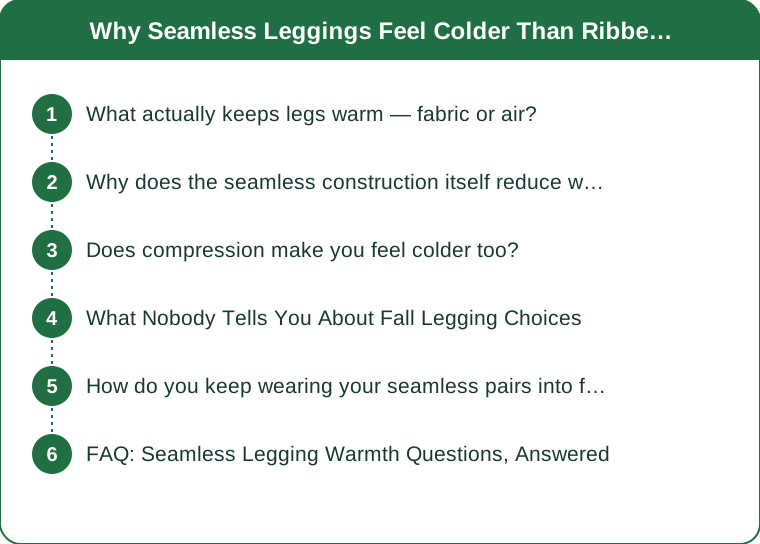
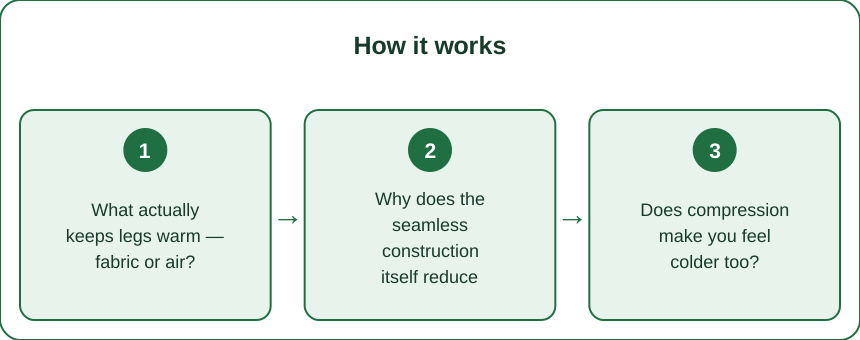
What actually keeps legs warm — fabric or air?
Air. Almost entirely air.
Insulation is a measure of how well a material traps still air, because still air is a poor conductor of heat and moving air is an excellent one. Fibers themselves conduct heat reasonably well; their job is to hold air in place, not to block cold.
This is why a lofted fleece at 200 gsm is far warmer than a dense woven at 300 gsm. The fleece is mostly air held in a structure. The woven is mostly material.
Seamless knitting is optimized for the opposite outcome — a smooth, uniform, compressive fabric face with minimal bulk. That’s exactly what you want for a fitted look under clothing, and exactly what you don’t want at 50°F.
Why does the seamless construction itself reduce warmth?
Seamless garments are knitted in the round on circular machines, building the whole leg as one continuous tube with zone changes built into the knit pattern rather than sewn in.
That process produces a flatter, denser gauge with tighter stitch density in the compression zones. Density is good for shape retention and squat-proof opacity. It’s poor for loft.
Ribbed knits do the reverse. The alternating raised and recessed columns create a corrugated cross-section, and each valley is a small pocket of still air held against the skin. The rib also expands and contracts, which means it traps air even as the fabric stretches.
Run a hand across both and you can feel it — one is smooth and cool to the touch, the other has texture you can catch a fingernail on.
Does compression make you feel colder too?
It can, for a reason that has nothing to do with fabric.
Compression garments apply graduated pressure to the limb. That’s useful for perceived support and, some evidence suggests, for recovery. But firm compression also flattens the microscopic air layer that normally sits between skin and cloth, which is a genuine part of your insulation.
There’s also a sensory component. Skin registers a cool, smooth surface making full contact as colder than a textured surface making intermittent contact, even at identical temperature. It’s the same reason a metal chair feels colder than a wooden one at the same room temperature — conduction rate, not temperature.
So a high-compression seamless legging is losing warmth on two fronts at once: less trapped air, and faster heat transfer at the point of contact.
What Nobody Tells You About Fall Legging Choices
Fabric weight on the tag tells you almost nothing about warmth. Two 240 gsm fabrics can differ enormously depending on construction. Loft is the number nobody prints.
Moisture changes everything. A seamless legging that wicks efficiently pulls sweat to the surface where evaporative cooling happens — great in July, actively cold in October when you stop moving.
Black doesn’t help as much as you’d hope. Dark fabric absorbs more solar radiation, which matters in direct autumn sun and does nothing on an overcast day or after dark.
The waistband is a bigger deal than the legs. Core warmth drives whole-body thermal comfort. A high-rise pair that covers the lower back genuinely feels warmer than a mid-rise in the same fabric.
Wind is the multiplier. At 50°F with a 10 mph wind, an unlined knit of any construction is being ventilated continuously — that’s a shell problem, not a legging problem.
How do you keep wearing your seamless pairs into fall?
You don’t have to retire them. You have to change what goes around them.
Add a base layer underneath. A thin merino or synthetic legging under a seamless pair adds a trapped air layer without changing the fit through the hip. This is the single most effective fix and costs nothing in silhouette.
Save seamless for high-output sessions. They’re excellent when you’re generating heat continuously — running, intervals, anything above a brisk walk. Their weakness shows up on stop-start activity and standing around.
Move ribbed and brushed-back pairs to the front of the drawer for walks, errands, outdoor coffee, and warmups.
Layer a windproof shell for anything under 45°F with wind. No knit construction solves convective loss on its own.
And give yourself the first ten minutes before judging — skin blood flow takes several minutes to adjust when you step outside, and a lot of pairs get unfairly blamed for the transition.
FAQ: Seamless Legging Warmth Questions, Answered
Are seamless leggings just worse for cold weather?
Not worse — differently optimized. They’re built for fit, opacity, and stretch recovery, and they hold those advantages year-round. Warmth just isn’t a property the construction prioritizes, so you supply it with a layer instead.
Would a thicker seamless pair fix it?
Partially. Going up in weight helps, but a heavy seamless knit still has less trapped air than a mid-weight ribbed one. You’d get more warmth per gram from a brushed interior than from added density.
Why did they feel fine last October?
Often because you were more heat-acclimated at the end of summer than you are now, or because you were more active in them. Perceived cold shifts several degrees across a season for the same person in the same clothes.
TL;DR:
- Insulation comes from trapped still air, and seamless knitting deliberately minimizes loft.
- Ribbed and brushed constructions hold air in their texture; that’s the whole difference.
- Compression flattens the natural air layer against skin and speeds heat transfer.
- A thin base layer underneath restores warmth without changing the fit you bought them for.
Your seamless pairs aren’t failing — they’re doing exactly what they were engineered to do, which happens to be the opposite of what a 50°F morning asks for. Keep them for the sessions where you generate your own heat, put something ribbed or brushed on for everything else, and stop reading fabric weight as if it were a temperature rating.
See It in Motion
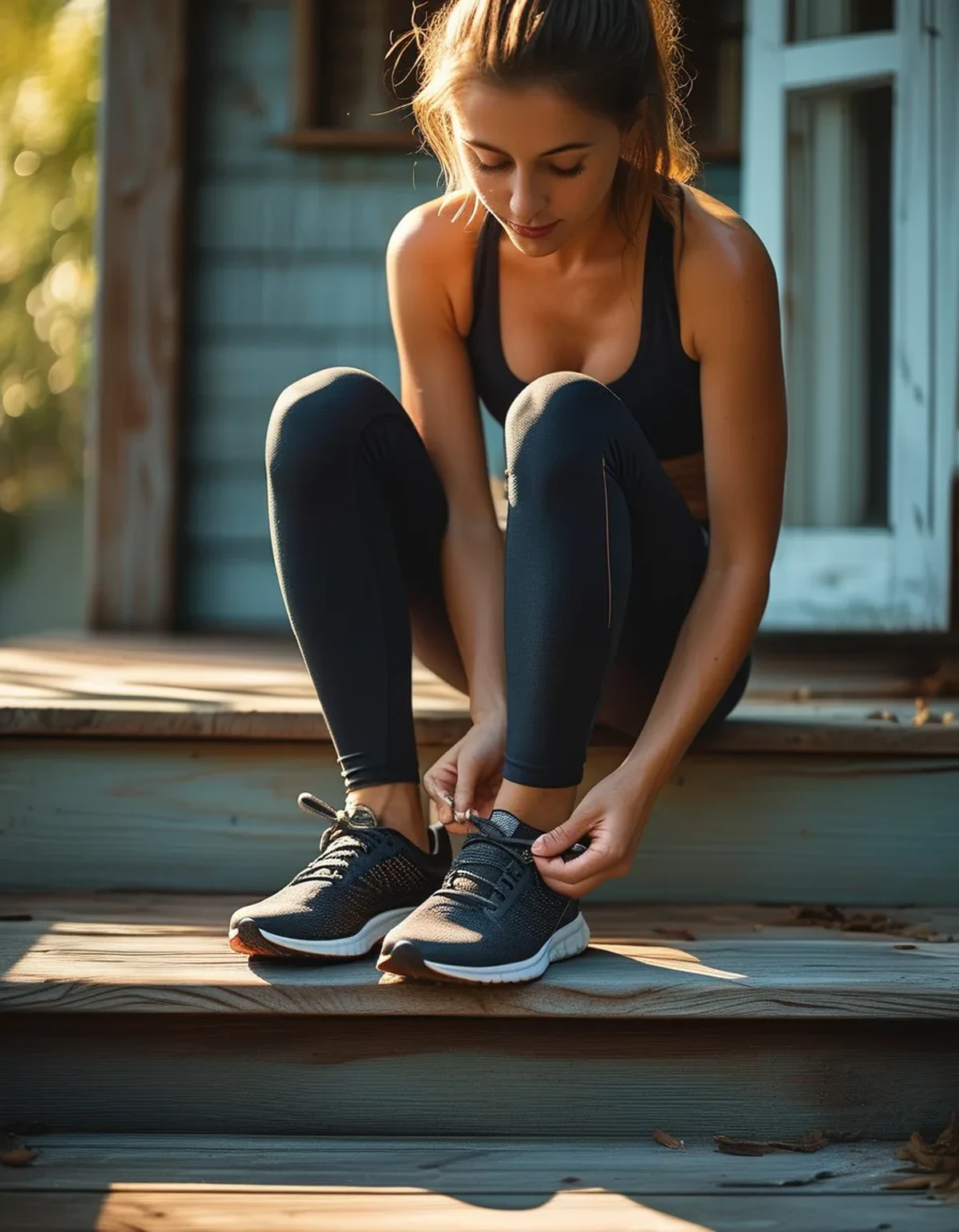
Seen here: Super High Waist Embossed Yoga Leggings with Inner Pocket — shop it on bubblelime.com
Keep Reading
This article is for general informational and styling purposes only. Fit, sizing, and product availability may vary.