Why Fabric Weight Matters More Than Brand Name for Seamless Leggings
Quick Answer: Heavier fabric weights, generally above 250 grams per square meter, tend to offer more opacity, structure, and squat-proof coverage, while lighter weights below that range prioritize breathability and a barely-there feel but sacrifice some coverage and durability — matching fabric weight to intended use matters more than brand alone.
Two pairs of seamless leggings from different brands can perform completely differently even at a similar price point, and fabric weight is usually the reason why.
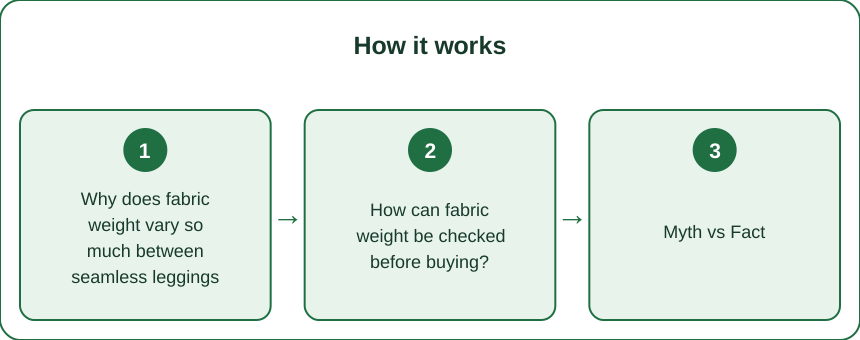
Why does fabric weight vary so much between seamless leggings brands?
Fabric weight is a direct trade-off between breathability and structure — lighter fabrics move more air and feel less restrictive, while heavier fabrics resist see-through issues and hold their shape better during movement.
Brands optimize for different use cases, meaning a legging marketed for yoga often uses a lighter weight than one marketed for heavy lifting or squats, even within the same brand’s lineup.
How can fabric weight be checked before buying?
Product descriptions increasingly list fabric weight in grams per square meter (GSM), though it’s still inconsistently included across brands and sometimes requires checking a size guide or material page specifically.
In-person, a simple stretch test — pulling fabric taut against a bright light to check opacity — is a reliable way to estimate weight and coverage without needing the exact GSM number.
Myth vs Fact: Seamless Fabric Weight
Myth: a higher price always means heavier, more structured fabric. Fact: price often reflects brand positioning and finishing details more than raw fabric weight, which can vary widely even among premium brands.
Myth: lighter fabric always means lower quality. Fact: lighter fabric is simply optimized for different use cases like heat management, not inherently lower quality than heavier options.
What weight range suits which activities best?
Fabric in the 250-300 GSM range tends to suit squats, heavier lifting, and activities needing maximum coverage confidence, since the added structure resists see-through under stretch.
Lighter fabric in the 180-220 GSM range suits yoga, walking, or warm-weather wear, prioritizing breathability over the added structure heavier fabric provides.
FAQ: Seamless Leggings Fabric Weight Questions, Answered
Does fabric weight affect how leggings pill over time?
Somewhat — heavier, denser fabric weaves tend to resist pilling slightly better than very light, loosely knit fabrics, though fiber content also plays a large role.
Is GSM the only number worth checking before buying?
It’s one of the most useful, but fiber blend (like nylon-spandex ratio) also affects performance meaningfully alongside weight.
Can fabric weight be felt by touch alone in a store?
Somewhat, though the light-opacity test is generally more reliable than touch alone for judging actual coverage.
TL;DR:
- Fabric weight, measured in GSM, is a more reliable performance predictor than brand alone
- Heavier fabric (250+ GSM) offers more coverage and structure for squats and lifting
- Lighter fabric (180-220 GSM) prioritizes breathability for yoga or warm weather
- A light-opacity stretch test helps estimate coverage when GSM isn’t listed
Check fabric weight before brand reputation — it’s the more reliable signal for how a pair will actually perform.
See It in Motion
Seen here: High Waist 8” Yoga Shorts — shop similar styles on bubblelime.com
Keep Reading
This article is for general informational and styling purposes only. Fit, sizing, and product availability may vary.